
2026 IFCII
In today's world, unprecedented changes are reshaping the order we once found familiar. The previously unified international rules are fragmenting, green trade barriers are rising, and the global climate finance system is experiencing profound rifts due to the withdrawal of major powers. At the same time, slowing economic growth and the restructuring of the geopolitical landscape have left countless enterprises, financial institutions, and ordinary households with a shared sense of bewilderment: old coordinates are failing, and new directions remain unclear.
The failure of old coordinates brings not only technical challenges of "how to do it," but also fluctuations in the conviction of "whether we still want to or can do it." The narrative of ESG is shifting from a peak of consensus to divergence and controversy; sustainable development has turned from a "shared goal" into an "optional choice" or even a "cost item." Policy swings and rule reversals in certain regions have amplified the market's skepticism toward long-termism: Will investments be repriced by new geopolitical and regulatory logics? Will commitments be forced to yield in the next economic cycle? As consensus weakens, many institutions are trending toward conservatism—lowering targets, shortening timelines, and retreating to familiar safe zones. Yet, it is precisely at this moment that we must ask: If sustainability is absent, what will support future growth? If resilience is not built, how will risks manifest in everyone's lives and on corporate balance sheets?
Our understanding of these dilemmas is this: In the face of uncertainty, the international community needs new leaders to step forward and drive sustainable development beyond mere slogans in a firmer, more actionable manner. In a divided world, more "bridge builders" are needed to bridge the gaps between different rules, capital, and interests, enabling cooperation to happen once again. More importantly, we must return to the essence: No matter how rules change or technology iterates, the ultimate destination of finance and capital should point to human development—ensuring that transition does not come at the expense of livelihoods, that growth can be shared by more people, and that the most vulnerable populations and regions are equipped to withstand shocks and access opportunities. Coordinates are not abstract concepts; they ultimately land on concrete individuals.
Based on this consensus, our thematic discussions will include: exploring the ESG challenges and responses of Chinese enterprises in their globalization process amid fragmented rules and rising green trade barriers; focusing on how finance can empower communities and vulnerable populations to cope with shocks, with "resilience" as the main thread; decoding the cognitive gaps and service disconnects in tech-finance through dialogues among banks, investment institutions, and innovative tech startups; and utilizing blended finance as a key tool to dismantle barriers and explore pathways surrounding two core bottlenecks: "how catalytic capital can effectively leverage commercial capital" and "how projects can become investable."
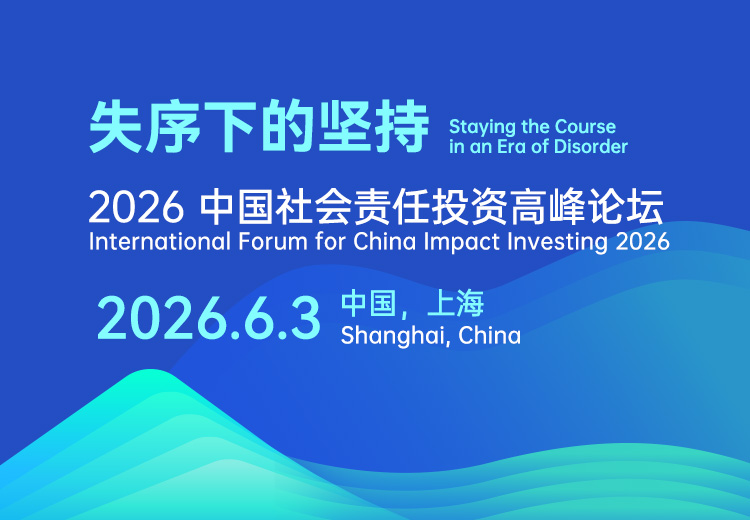
"Staying the Course in an Era of Disorder" is not about avoiding the harsh realities, but about anchoring our direction amidst turbulence: In this new world, we explore how to uphold our belief in sustainable development, rebuild confidence in cooperation, and bring commitments out of slogans back into real systems, real capital, and the real lives of people.